Showing posts with label concrete thinkers. Show all posts

Monday, December 21, 2015

Hobos, Goosebumps and Wiffle Balls

When my youngest son Tate was diagnosed with autism, he was around two and a half years old. Our story is similar to a lot of others I’ve heard over the years. There was an initial frantic search for services and therapies, years of early intervention that were hard to pay for, then denial that my son would be forever handicapped. Much progress was made and there were hopes of a “recovery” and then finally, there was acceptance.

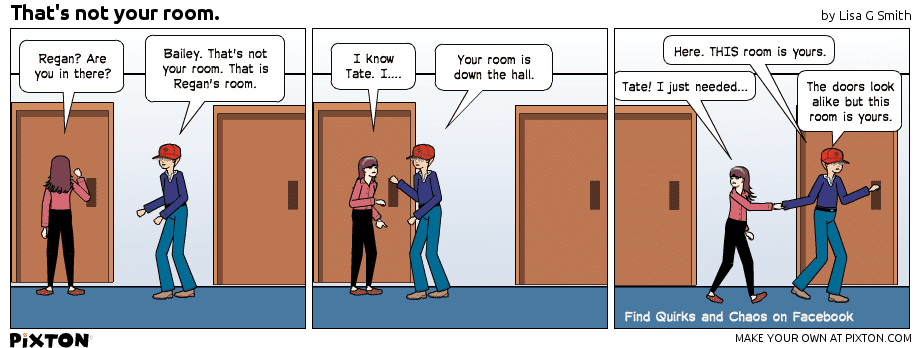
Some days are a little harder than others. Most days we do okay. A sense of humor helps. A lot. Knowing we are not alone also helps. I like to blog about our experiences in hopes that I can make things a little easier for the parents who are coming after me. Lately I’ve been illustrating some of the things Tate does that may seem a bit odd to others in an effort help people understand autism a little better.

At age fourteen, Tate still sometimes misses things that are very obvious to the rest of us. And sometimes he is sure he understands things the rest of us are confused about when the reverse is actually true. Because Tate sees the world differently than I do I am often learning things from him. I have learned to appreciate his unique take on things.  

Below are a few of the illustrations I have made so you can have a peek into our lives. There are many more to come so watch for future posts. 


He technically knew what he was talking about here.
Tate's tries hard to make jokes. He thought telling his sister that she was not really seeing cows was so funny to him. He sure schooled us on what a hobo is too.


Wiffle a ball? 

This is one of my favorite happenings ever. Tate was so excited to share his discovery.
He sure thought he was helping here. 

Figurative language is often a problem for Tate. 

If only we all said what we really mean...


Goosebumps have nothing to do with geese? 

I learned never to try to teach Tate about figurative language unless there are no distractions.


If you liked this post you might also like: There is no ham in hamburgers.

Friday, August 1, 2014

A Look Inside a Black and White Mind

If you know me very well you have probably heard me say that I believe I could almost get an Asperger diagnosis (or DSM Level 4 as it is now called). I have a lot of the characteristics. I was painfully shy as a small child and have never been a people person, although I have taught myself how to behave in most social situations, I still find it very difficult to interact sometimes. I am a visual thinker, thinking in pictures and categories. Ironically, being a visual thinker does not help me in the area of facial recognition. I do not recognize people’s faces until I have seen them several times. I am also a black and white thinker. By that I mean I have a lot of trouble with gray areas. In other words things are right or wrong and there is no in-between.

Many of the people in my life, even those who know me best, say I hide my insecurities in social situations very well. The story of how I learned to “fake it” goes back to my teen years. I had very few friends in grade school. I was in a large school district and very few of the same kids were grouped together year after year thus making it hard for a shy kid to form relationships. I had one friend in second and third grade that I was close to but the school boundaries changed after that and we were sent to different schools.

In the fourth grade I became friends with a girl who I truly loved. A lot of my childhood memories revolve around her. She moved away when I was in seventh grade and I spent the next year in a depressed state. There were two girls that year that got their kicks by bullying me and I had no idea how to defend myself. Then, at age 14, a couple things happened that changed my life. We moved. We moved from a VERY large school district to a VERY small school district. AND, my brother who was five years older than I, and the coolest, funniest guy who was always “the life of the party” told me something that forever changed my life. I told him how afraid I was to start at my new school. I told him how hard it was for me to meet new people. My cool brother, who had dozens and dozens of friends, told me that he was just as introverted as I was. He told me that I had to go into that school and ACT the way I wanted people to perceive me to be. I had to think of it as a play and I was an actor. I remember him saying that I had been a little fish in a big pond at my old school and I would have the chance to be a big fish in a little pond at my new school. I could totally change who I was by how I acted. I had the chance to redefine myself. I looked up to my brother like no one else I knew and I trusted him. I did what he told me to do. Within days at the new school I had made more friends than I’d had in years at the old one. Of course it helped tremendously that everyone at the new school was so welcoming and friendly. Those four years of school were amazing and because of those four years I went off to college well-practiced at making friends and maintaining friendships. I had mastered the art of social relationships, much later than my peers, but I had done it.

I am a visual thinker and categorize everything I learn or see. I had no idea that I think differently than the general population until I read Temple Grandin’s book “Thinking in Pictures.” I read her book when Tate was diagnosed with autism and I learned so much about myself. I knew and had always known I was “different” than a lot of people but had no idea why. I think differently. I did not know that everyone else did not think in pictures. I would still not know this had Tate not been born with autism and had I not needed to educate myself about it. Knowing that I think differently has helped me to understand so many things I had always considered a mystery.

Temple Grandin likened the way she thinks to a video player with clips of video she can pull from files. I would describe the way I think this way: I place the pictures I have and the “rules” I’ve learned in a sort of list and categorize them in a filing system, like a rolodex. I can think quickly through my files and find a picture or a rule that applies in most situations. When I was young my list of rules was shorter and I didn’t have a lot of “files” to draw from so I didn’t know how to act in a lot of situations. Consequently, I appeared socially awkward in new places and around new people. Now that I am older and I’ve had a lot more experiences, my list of rules and how to act in almost any situation that occurs is quite extensive. Everyone learns from their past experiences I know but apparently I am different in that I visualize my list or quickly run through my list of rules so that I can decide what responses will be socially appropriate. It doesn’t just come naturally for me. As a young adult I sometimes misjudged and came up with an inappropriate reaction occasionally. I rarely do that anymore because I have memorized and know how to use most social cues and respond appropriately. Thus, I appear very “normal” to the world. Don’t get me wrong, I feel very “normal” all of the time. This way of thinking and my rolodex works for me. It may be different than the way you think but it works for me. I get by just fine and up until a few years ago I had no idea that my way of thinking was not universal with human beings. HA

It makes no sense to me that a person who thinks in pictures like I do has such a hard time with facial recognition. I am what some call face blind. I recently read almost two percent of people have this issue. I have to meet someone more than once, and usually several times, before I can memorize a face. Then, when I see them in a different setting than I met them in, I am unable to identify how I know them. I often recognize people by their voices though so sometimes if they speak to me that can save me. Sometimes I can tell who a person is by the way they walk. If I see them walking toward me or away from me I might be able to identify them but if I walk up on them then I struggle for to place them. This inability to recognize faces is a real handicap for me and I appear to be a snob often as I walk right past people that I should be stopping to speak to. I honestly do not understand how everyone else DOES seem to recognize a face after one encounter. Unlike people with autism, I do not have any trouble with eye contact so that is not the issue. I think it is that people basically all look similar to me. Oh, there are differences, like hair length, body shape and size, and color too. So that all helps but I see maybe one of a dozen different faces when I meet someone. Weird, I know. If there is something very unusual about a person then I will recognize them after one meeting but otherwise, it is not going to happen. Most of the time when I meet someone I think, “She looks so much like ______.” However, when I mention to someone else that I think the two look similar they usually will not agree. I volunteer one day a week with a teacher friend in our local school and it takes me all year to match the kids' faces to their names. Some I never learn. That is just not "normal." Movies, especially old ones, are a real big part of our family life but I can rarely tell the actors and actresses apart. I take a lot of teasing over that.

I always dread hearing the words “gray area” because I know there is going to be a conflict my mind will have to wrestle with. There are almost no gray areas for me. Gray areas do not fit in file folders. There is no place on the rolodex for gray areas. You see, when you are a concrete thinker like myself, issues are black and white, right or wrong. I recently heard a doctor refer to concrete thinking as “rigidity of thinking.” I thought that was a pretty good way to describe the way I think. There isn’t much flexibility. There is a right way to do things and anything other than that one way, is wrong. And THAT folks, is the reason I can sometimes come off as self-righteous, calloused, or uncaring. My patient husband has taught me to rewrite many of the rules on my mental rolodex. I now can accept that there is more than one way to do some jobs and still get satisfactory results. He has taught me that people who do not do things exactly the way I do are not always “bad guys.” My rolodex continues to expand. So, why don’t I just accept all gray and expand every day? It is not that easy when you are a concrete thinker. Each bit of gray has to make sense. It has to be tried in the courtroom of my mind. If it doesn’t make sense and cannot hold up then it will NOT be added to the rolodex. Many, possibly even most, of the gray things I am asked to consider do not even get a trial date. HA. I am being a bit facetious but this  is sort of how it works for me.

I do not have autism. I have a great imagination, a sense of humor, super eye contact, and no problems with communication, empathy or theory of mind. I do not have any stereotypic behaviors or a lot of sensory issues. I do not perseverate (obsess) on things (although around election time, some might argue about that one.) HA Oftentimes, relatives of a person with autism have some of the characteristics of autism. That would be me.

I am 51 years old and still adding to some of the “rules” I probably should have known for a long time. Moral issues, biblical principals, and God’s commands are extremely easy for me to believe and obey because God’s word is very cut and dried on most issues. It is the social rules and relationships that have always been harder for me. If I wrong someone then it is very hard for me to forgive myself. I spoke in anger to a friend several months ago, apologized, and was forgiven yet I am still ashamed of myself over it. If someone wrongs me or betrays a trust then I will probably never be able to confide in them again. My respect for them is gone. I can forgive them. I can love them. I can be nice to them, but I will not ever trust them again. 

I illustrate my thoughts and feelings with pictures all the time. It is how I think. Following is an example of how I pictured it recently when someone I love did something that hurt me, and others. My mind saw a clean, steel kitchen sink, full of clear water. There was a drain in the bottom of the sink and a stopper in the drain. When my friend did the horrible thing he did, the stopper popped out of the drain and all the water quickly ran out. The water was my respect (not my love, just my respect). It is gone. The sink is dry. I have tried to refill the sink but the stopper just will not hold. Can I try and visualize another stopper and fixing the sink? Oh, I can try; and try; and try again; but there is only so much a concrete thinker can do. Can I change? I've been trying for at least forty years and praying about it daily. If anyone can soften concrete God can so I will keep praying and trying. 


You might wonder why would I want to write a blog post like this? People will think I am “weird” now. I have a couple of reasons. The first being the usual: to raise awareness and tolerance for people with autism. Sharing some of the same characteristics with Tate, perhaps does give me some insight into how he thinks and feels. Secondly, I have tried to describe some of these things to my family and close friends before and wanted to get some organized thoughts on paper. Hopefully, this will explain a few things.

If you liked this post then these two would be recommended for your reading pleasure: Why does Tate act that way? and Look into my eyes.


Like what you read? Want to become a follower? Click on the Google Friend Following gadget on this blog. It's over on the right side and asks you to subscribe. Or you can add the URL (the web address in your search bar) to your Reading List. You can do that by clicking the plus sign in front of the URL. Thanks! 

Thursday, January 17, 2013

we have to "give them a clue"


A couple of days ago, I got groceries and had just begun moving them from the cart to the van when a young man came up behind me, very quietly, and startled me. I think I actually jumped. He was waiting for my shopping cart. He works at the store and wanted to return my cart to the store for me. It would have been much more convenient for me to stick it in the cart-return next to me when I was finished, but he thought he was doing me a huge favor by standing there and waiting. He didn’t SAY he wanted to return the cart for me. He just said, “hello” and stood and waited. I could tell he had autism for several reasons. He had the awkward gait, didn’t know what to do with his hands or eyes while he stood waiting, and he had a monotone voice. It was very cold outside and I commented about the temperature. He tried to have a conversation with me about the weather but didn’t really know how. I helped him like I would my son Tate, bouncing “the ball” back to him and asking concrete questions that he would know how to answer. He reminded me so much of Tate and how he would have conversed with someone. 

Tate with Melissa, one of his first
(and best) teachers. 
Last week, our good friend Melissa visited our congregation and worshipped with us. Melissa was one of Tate’s first teachers in his early intervention program. Tate so badly wanted to have a conversation with her. He tried with, “Hey, a church building is where you go to church.” Melissa replied appropriately then Tate tried again: “A few days ago, Levi did something.” Melissa said, “What did Levi do?” Tate said, “He fixed the game cube.” Then he sauntered away without properly ending the conversation. When Tate has a conversation with someone it is usually two exchanges with him pacing back and forth in front of the person he is conversing with, or bouncing in place. The church building is a great place for Tate to practice his social skills. After many worship services I grab Tate before he bolts from the building to sit in the car, and I tell him he has to visit with three people before he can leave the building. He hates it when I do that. He usually picks the same three people, so sometimes I tell him it has to be three people he doesn’t usually talk to. The poor kid. The poor victim he chooses too! Haha They are all great sports and give it their best effort. It is just hard to get him to make any eye contact or make much sense. I’ve turned my church family into speech therapists for Tate. 

The day after I had the exchange with the young man while I unloaded my groceries, I was in another store and saw another young man with autism. This guy was probably about 15 and was there with a teacher or mentor who was supervising him. I imagine the outing was a teaching experience or perhaps a reward for something. The teacher was doing a fantastic job of modeling appropriate behavior for the student. I did not gawk but I was in the same vicinity for quite a while so I listened. The student bounced on his toes when he walked, much like Tate does, and he had trouble knowing what topics were appropriate for conversation. He talked at length about his high score on “Bop-it” and he wanted to talk at length about a brand of bread that he didn’t often see on store shelves. I imagine the teacher was having a hard time keeping a straight face part of the time because the bread topic was so far out there. Tate does the same sort of things. He has no idea what is appropriate to talk about and what is not. He has no idea what kinds of things are interesting to other people and what things are not. 

Tate has announced to his peers at school before that he was going to take a shower when he got home and he sometimes tells his teachers he had a shower that morning. We’ve tried to teach him that other people don’t really care to hear about his showers. He recently tried to start a conversation by telling one of the staff at school that her skin looked old. She is a young woman, quite pretty, and she handled it very well but we all had a good laugh over that one later. A day or two after that incident Tate had a substitute in his classroom that was elderly and her skin was wrinkled. I was so worried about what their day was like. If Tate said anything inappropriate, I didn’t get to hear about it. I wanted to be a fly on the wall that day. On Veteran’s Day, the school invited local veterans to come and have lunch with the students. Tate walked into the office with his para, looked around at several older folk gathered in the office, and started to speak. Tate’s wonderful, insightful, wise para, quickly said, “Tate, think about what you are going to say, before you say it.” Tate said, “Oh, never mind.” Tate just calls it like he sees it, as do most people with autism. 


Tate’s Resource Room teacher and his Speech Therapist are always working hard on teaching conversation starters and how to sustain a conversation. It just doesn’t come naturally to a kid with autism like it does the rest of us. They are teaching him how to tell a joke and the poor school secretary has heard a joke a day for most of the year now. She is so accommodating and laughs for him. She is worth her weight in gold and a huge part of his day.

I cannot imagine how confusing it must be to live in Tate's world. I remember once saying something about "laughing my head off" and Tate coming over to me to inspect my neck. He needed to make sure my head was still attached. Recently someone commented on being "ate up with chiggers" and Tate looked extremely confused.  

We are all working on figurative language. Each week, Tate’s Resource Room teacher sends me a list of three to five new idioms or cliché’s they will be working on that week so I can reinforce them at home. It is so cool when I hear him use one of those at home. He has learned things like “I’m on fire” and “under the weather” and “letting the cat out of the bag.” These are the things that we all understand when we hear them due to the context. They have to be taught, systematically, to a person with autism. Otherwise, they will not “have a clue” what you are talking about.

If you have not ever read, Seeing Ghosts, then click on the link and enjoy. 

Find me on Facebook at Quirks and Chaos. Like what you read? Want to become a follower? Click on the Google Friend Following gadget on this blog. It's over on the right side and asks you to subscribe. Or you can add the URL (the web address in your search bar) to your Reading List. You can do that by clicking the plus sign in front of the URL. Thanks!